Atmosphere Is Not Generated Instantly
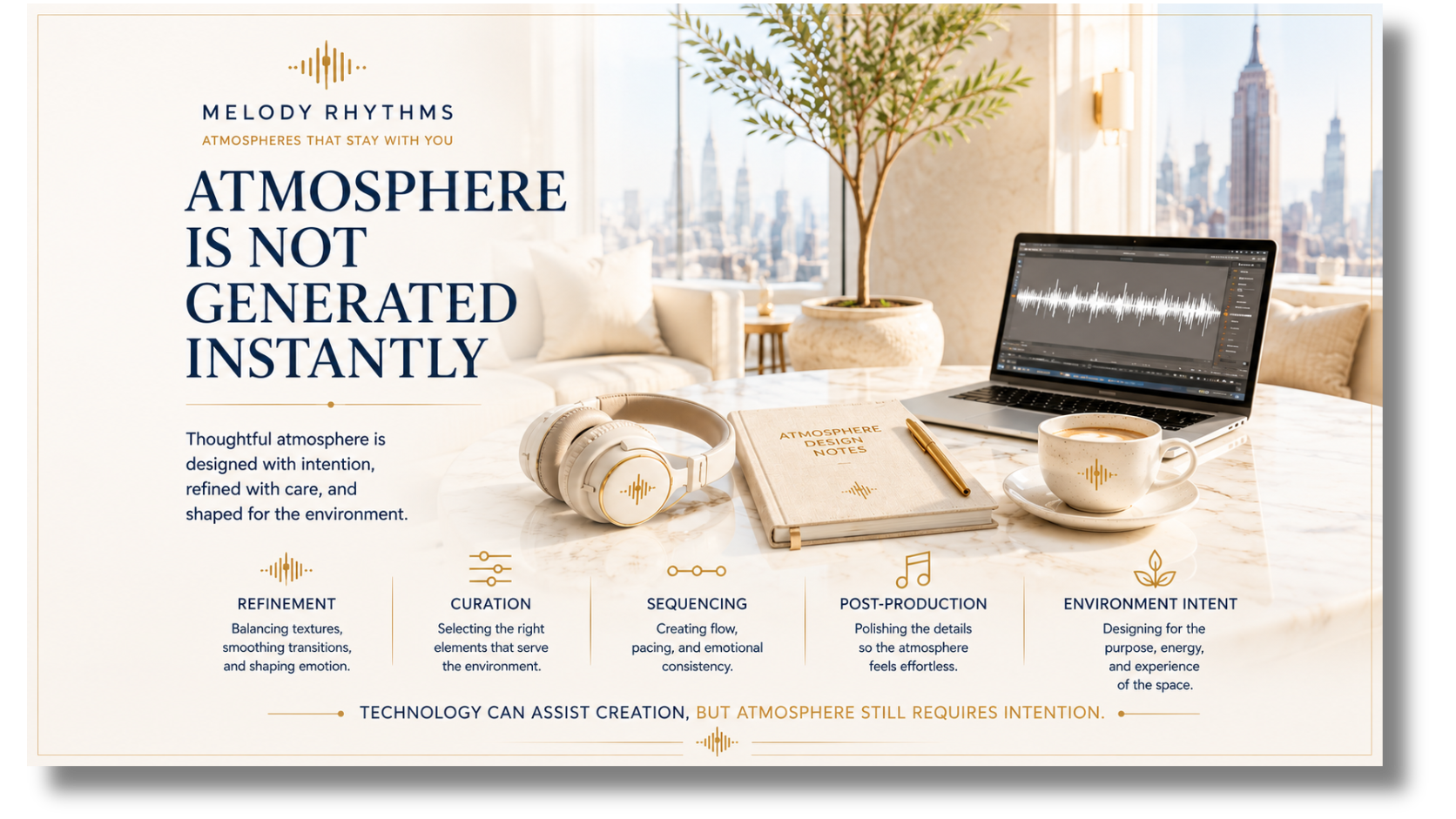
The Conversation Around AI Generated Music Often Focuses On Speed.
Instant creation. Instant results. Instant output.
But thoughtfully designed atmosphere does not happen instantly. Especially in hospitality, wellness, lounge, and environmental settings, sound must do far more than simply exist in the background. It must support emotional pacing, complement spatial design, and create cohesion within the environment itself.
“Generation may begin the process. Refinement is what shapes the experience”
Atmosphere Requires Emotional Consistency.
Not every sound belongs in every environment. A rooftop lounge should not feel emotionally identical to a wellness space.
An arrival experience should not carry the same pacing as an evening cocktail environment. Even subtle inconsistencies in tonal balance, energy, transitions, or pacing can quietly change how a space feels.
In atmospheric design, emotional consistency matters. The goal is not simply to create music, but rather to create environments that feel intentional from beginning to end.
Raw Generation Is Only One Layer
Generated outputs often require extensive refinement before they can support a sophisticated environment cohesively.
Transitions may feel abrupt. Endings may sound overly harsh. Tonal balance may shift unexpectedly.
Some compositions may carry too much density for quieter environments, while others may lack the warmth or pacing required for hospitality settings.
In many cases, refinement becomes less about correcting mistakes and more about shaping emotional behavior within the environment.
Small adjustments can completely change how a space feels over time.
Designing for the Environment
Atmospheric sound is deeply connected to the purpose of a space. Arrival environments often require softer pacing and emotional openness.
Lounge and waiting areas may benefit from slightly warmer rhythmic movement and conversational balance. Dining environments often require subtle momentum without emotional fatigue. Wellness spaces demand restraint, softness, and spaciousness.
The environment itself influences the creative direction. Sound should never compete with the space.
It should support it.
Refinement Shapes Trust
The most effective atmosphere systems often go unnoticed. Guests may not consciously identify why a space feels calming, refined, or emotionally balanced, but they respond to it subconsciously.
That response is shaped through pacing, tonal cohesion, sequencing, emotional restraint, environmental awareness, and careful refinement. Atmosphere is rarely defined by one single element alone. It is created through layers working together cohesively.
Technology and Human Direction
Modern creative tools continue to evolve rapidly, creating new possibilities for environmental sound and atmospheric design. But technology alone does not replace intentional creative direction.
Atmosphere still requires emotional awareness, refinement, pacing, and cohesive design thinking. Technology may assist the process, but thoughtful atmosphere is still shaped through human intention.
The environments people remember most are rarely accidental. They are shaped carefully through emotional pacing, refinement, and environmental awareness long before the experience reaches the listener.
Because atmosphere is not simply generated.
It is designed.